
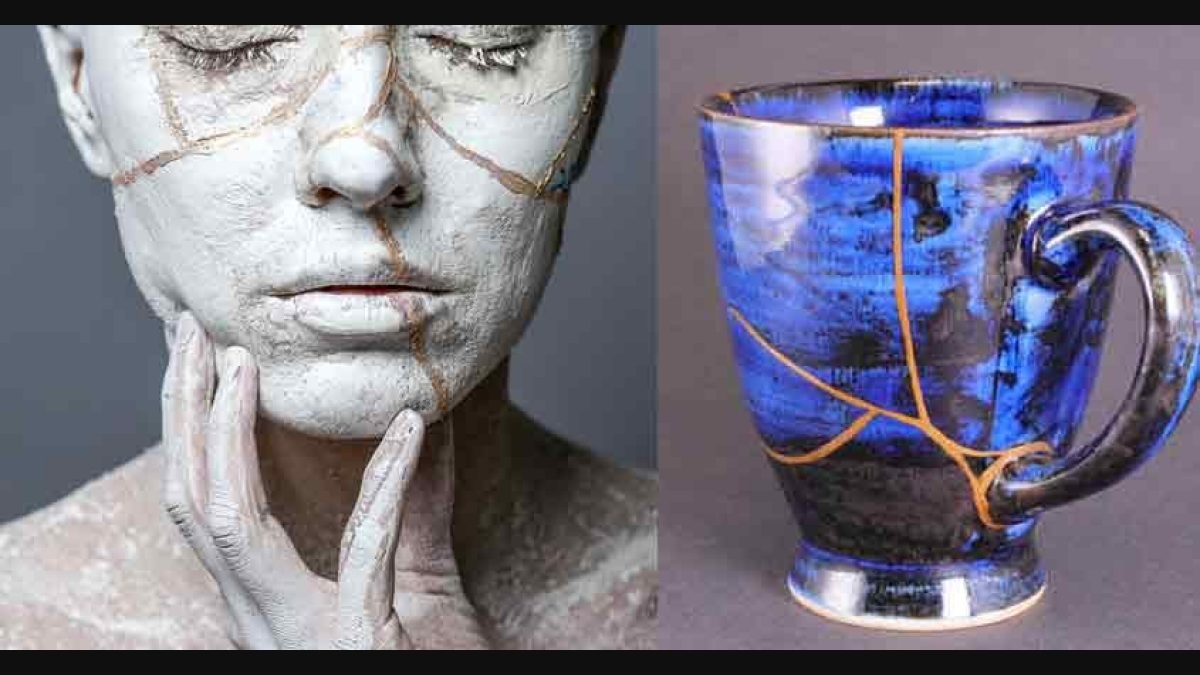
Kintsugi is the Japanese art of fixing what is broken ( mostly pottery) with gold. It is built on the idea of embracing imperfections and the notion that you can create something more beautiful than what was broken. There are too many broken pieces and our constant need to fix. A friendship that does not last the lifetime you thought it would, a relationship that has you filled with doubts and anticipating when it would break, the need to fix what is not even broken yet. It is like we live in a constant state of breaking and mending.
I had not realized it but so many broken pieces lay around me and I did not know what to do with them. Sometimes we think a situation or someone is completely broken and there is no way of putting back the pieces together. Sometimes we break people and carry around the burden of regret thinking if only I did not say that or If only I never met the person in the first place. Kintsugi is there to remind us that the broken can be fixed and its okay if we are not the same people to do the fixing. Mosaic art is there to show us that different broken pieces can make something more adorable than the original creation. Today’s deep dive is the aftermath of my book club’s read of the month ( September).

Young Adult books have never been my cup of tea. It is mentally disturbing that they are written by adults and I do not know what it takes for them to create such a young narrative. We had two options; a book that was described as sad Orbiting Jupiter by Gary D. Schmidt and Our Chemical hearts which was described as a love story. My fellow book club members opted for the love story but I wanted to see what could be intricately sad about Orbiting Jupiter.
I remember their astonishment when I reported that the book was not sad but mostly normal. We had a moment of them checking in and me clarifying that I was completely fine and just wanted to find out how sad a book could get. Nothing has topped Norwegian Wood by Haruki Murakami for me in that spectrum but I have also not been actively searching for sad books. Perhaps a little life by Hanya Yanagihara will top that list but its too long, and not captivating enough for me to bear through the end to find out. ( maybe I am not mature enough for the book but I see myself getting there and reading it to the end ).
I found this book sad. More sad than Orbiting Jupiter. Maybe it is because I went in expecting a love story that develops through Middle school only to be hit by grief, pity and so much wisdom about love. This writing is broken somewhere between being an editor’s post and a book review but the golden thread should guide you. As usual, I’ll now leave the golden nuggets from the book to bait you into picking and reading the book yourself.
Stories with happy endings are just stories that haven’t finished yet.
This phrase would mean that there are no happy endings.. I do not think that in this context the opposite of happy is sad and that endings are two sided like a coin. They are probably a continuum. If the author suggests happy endings are just stories that have not yet finished they could be anything else along the continuum. My explanation may only be a different way of expressing what the author meant and maybe she might have been onto something.
Because apparently you still have to chase girls who can’t even run
This was hilarious especially In the context of the book. I do believe girls should be chased but I did read somewhere that neither the girl nor the boy is the price. While in the relationship girls too do some chasing. At the end, love is the price and that’s the motivation for the chase anyway.
Everything dies love included. Sometimes it dies with a person, sometimes it dies on its own. The greatest love story ever told doesn’t have to be about two people who spent their whole lives together…. There’s nothing like a failed love, all love is equal in the brain.
Full disclaimer.. these nuggets of wisdom are not evenly spread through the book. You might struggle reading the first 77 pages like I did. Humour is what mostly kept me going and the fact that I needed to contribute on the conversation during my bookclub whether in praise for the book or tearing it apart. We had a fair share of both.
Not to leave your palate distasteful, one of the characters has this to say about why people fall in love again despite having being heartbroken .
Because the journey is beautiful in the beginning and no one can see the bend in the train tracks until it is already too late to stop and when you board the train you hope that this is the one that doesn’t crash even though it might be, even though it probably will be, it’s worth getting on anyway to find out.
Our chemical hearts.
 Dimples Migraines and Aahs